Showing posts with label Apple. Show all posts

Tuesday, October 16, 2012

iPad mini will present on October 23


We have previously written about the fact that the announcement of a new tablet iPad mini could be held on October 17, however, usually prior to such events to send out invitations in advance did not happen - it took just now. Apple announced on its new presentation, October 23, and not in the Yerba Buena Center for the Arts in San Francisco, as usual, and in San Jose, California Theatre at 10 am, the time the Pacific Coast.
Traditionally, the details of the subject event the company has not disclosed, but is expected to be announced is a mini version of the iPad with a 7.85-inch touch screen. At the invitation stated that the company "has a little more to show you" (we've got a little more to show you). Presumably, this is an allusion to a more compact tablet from Apple, though a week of it is anyone's guess.

Apple Sends Invitations for Oct. 23 Event


Apple AAPL +2.34% has just issued invitations for an event next week on Oct. 23.

The tagline for the event is, “We’ve got a little more to show you.”

Given that the event is widely expected to be an unveiling of a smaller iPad, the word “little” is probably not used lightly. Apple could, of course, unveil other products during the event as well.

It’s also worth noting that Microsoft unveiled the price of its Surface tablet today, which is priced similarly to the iPad, only to have Apple issue the invitations for its next event several hours later.

AllThingsD, a sister website to The Wall Street Journal, first reported that Apple was planning an event to unveil the smaller iPad.

Apple‘s Asian component suppliers have already started mass production of a new tablet smaller than the current iPad — the so-called iPad Mini — that’s destined to compete with Google‘s and Amazon’s new tablets, according to an earlier report in the Journal.

The event will be held in San Jose at the California Theater — a bit of an usual choice for Apple given that it has recently typically held events in San Francisco or at the company’s campus in Cupertino, Calif.

The event will be held at 1 p.m. ET.

source

Inside the Apple Lightning Cable


We couldn’t help but notice that there is a lot of speculation and discussion (and frankly, a few wild guesses) concerning the functions of the Apple’s new lightning connectors. We don’t normally give (a total of five blogs!) this much attention to a single electronics teardown, but since we haven’t seen it elsewhere yet, we figured the world needed “just one more thing” on the Apple iPhone 5. We have confirmed that the Lightning cable does have four chips embedded in it, plus some passive devices. Two of these chips are very simple (only a couple of transistors), and the third is an NXP NX20P3. However, the fourth and arguably most interesting of these is the TI chip.

The above images show the location of the TI chip on the lightning connector. Once we stripped away the cable housing (easier said than done), and took the die out of the package, we found die markings of “BQ2025”. (See our die photo below). This part number is not published by TI.

However, TI does have published datasheets on the BQ2022, BQ2023, BQ2024, and BQ2026. These four chips are cataloged on TI’s website as battery fuel gauges, but they are not identical, with three of them being serial EPROMs and one of them being a battery monitor IC.

However, all four do have some common characteristics. All use a single wire SDQ interface (TI’s proprietary serial communications protocol), and all have some basic security features such as CRC generation. So, it is certainly likely that the BQ2025 does have some security implemented on it. It would also seem likely that it includes an SDQ interface.

We continued our lab work on the BQ2025 and now have a lower metal sample to view (and purchase in the Chipworks store). On this sample, we have been able to see some further details of this chip. There is a digital logic block occupying the top left portion of the chip. This block includes about 5K gates of logic. Also on the chip is the EPROM, with likely 64 or 128 bits of storage (visual inspection only, full RE not completed). There are also some large driver transistors, quite a bit of analog circuitry, and a fair amount of capacitance. This is certainly all consistent with a serial communication chip including some simple security features.

Part of the magic going on is that the Lightning connector features fewer direct connections than the prior generation connector. This means that Apple needs to apply some intelligence to what wire is sending and receiving the signals because there are fewer connections, but just as much data. Additionally, Apple has a number of patents related to authentication and security between devices. This has useful application by allowing “handshake” access to only certain function necessary for the functioning of a peripheral (such as a speaker docking station) without allowing access to the full functionality of the phone. It has additional application in smart battery applications. Both Apple and Texas Instruments (separately) have documented this security technology in a number of related patents (applied and issued) wherein they describe the passing of information from the host through to the accessory. For those interested, here are a few patent numbers, with the last being a TI patent:  20100173973A1, US8200881, US8239605, US8086781, US8161567, US823881, US8245041.

It is actually very interesting that we may have found a chip with (likely) some modest security in this cable. In this case not only related to securing their revenue stream for cables or ensuring reliable and high quality (licensed) peripherals, but in delivering useful product features that are not necessarily in the consumers top of mind. We are planning a full systems analysis on this device to further understand what exactly is going on.

Previously, we have analyzed security devices regarding medical printer media (armbands), printer cartridges, flash drive memory, batteries, and smart cards, but this is the first secure cable we have seen. The security does not come close to the herculean approaches that are used in (for example) today’s printer cartridges, but resembles the level of effort that cartridge manufacturers used to implement in the olden days. In other words, at this time the security is “just enough.” With future generations of Apple and non-Apple products, we may begin to see even stronger security and control if the market forces merit it.

To complete the story, let’s look at the other three chips on the lightning connector board. The NXP NX20P3 includes one huge transistor occupying over 75% of the die area. It also has a fair amount of analog circuitry, as would be consistent with their line of charging devices for peripherals – from our last trip to the Applied Power Electronics Conference (APEC) we know that this is a market that NXP is very strong in. The last two dies appear to be simple power transistors.Good design wins again for TI and NXP!

http://www.chipworks.com/blog/recentteardowns/2012/10/15/inside-the-apple-lightning-cable/

Monday, October 15, 2012

Samsung and Apple are about to break the contract to supply parts?

A senior company Samsung, on condition of anonymity, told The Korea Times that the South Korean manufacturer of components and the American company Apple are on the verge of breaking commercial relations. According to him, the problem is that Apple representatives have indicated that they do not intend to re-use technology of its main competitor. One of these steps to get rid of the influence of the competitor study was transferring production chipset A7 at the facilities of TSMC. At the moment, this processor has not yet developed, but it is expected that TSMC is not worse Samsung cope with production quad chip for 20-nm process technology. At the same time, the current 32nm A6 is Samsung, although it was entirely developed inside Apple. About that Samsung and Apple d present the main competitors in the market says a lot of facts. Including not only direct market competition, but also a great number of trials around the world, which are regularly covered by media. At the same time, Samsung is one of the largest semiconductor manufacturers and a major supplier of components for Apple. In the case of termination of contracts real hit both companies: Samsung will lose billions of dollars of contracts for the supply of its products, and Apple will have to find new producers, solving the issue of control of quality and production of sufficient production in a short time.

Some details about the tablet iPad Mini

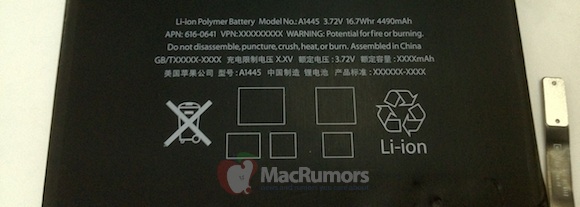
Despite the well-protected by Apple confidential information on future devices, it is still occasionally falls into the net. Thus it became the tablet and iPad Mini, which has not been officially announced, but the fact that it is a model with a 7.85-inch screen is already known. Now it became known, and other details concerning its battery and cost of the device, depending on its characteristics. lithium-ion battery iPad Mini will have a capacity of 4490 mAh or 16.7 watt-hours, and to give them a voltage 3.72 V. Thus it is intermediate between the battery iPhone 5 (5.45 Wh) and third-generation iPad (42.5 Wh). tablet iPad Mini will be available in 16 different variants, half of which will be designed as a black and half - white. Most of the budget will be a version of the device with 8 GB of internal memory and without the module 3G - its price is 250 euros (or dollars for the U.S. market). 350 conventional units will cost 8 GB version with 3G or 16GB without that module. A further step adds 100 dollars or euros for a doubling of internal memory module or radio. In this case is a top version with 64 GB of internal memory and 3G antenna, which will cost 650 euros or dollars. 


Apple iPad mini shows up with prices in the system of Media Markt


No official announcement, no official date -. Yet the iPad emerges mini now already with prices in the internal system of the Media Markt chain caschy his day spent a few years in metro stores, including both Media Markt and Saturn are, he can therefore confirm that it is indeed the internal system. This information is due to Florian, who on his blog published the following screenshot :

In this system, we now have both the iPad mini even listed, but also the different memory sizes, and more importantly, the prices. We should perhaps be confirmed only with caution, because it is not out yet if this is now truly the "real deal" is, or whether it is here only once is only a placeholder that will be replaced later by the actual prices . In addition, I've just in the post by friend caschy learned that in each local market, such data can be entered. Surely we can be so only if we know that this data has been entered centrally and be available in all markets in the system.

But here the most important thing - the prices! The Go Go at 249 euros, confirming that Apple has of course the competitors Amazon and Google in mind. Next we learn from this information that will support UMTS, LTE, but apparently not. Here are the prices from the media market system:

249 euros: Apple iPad Mini 8 GB Wi-Fi
349 Euro: Apple iPad Mini 8 GB Wi-Fi and UMTS

349 euros: Apple iPad 16 GB Wi-Fi Mini
449 Euro: Apple iPad 16 GB Wi-Fi Mini and UMTS

449 euros: Apple iPad 32 GB Wi-Fi Mini
549 Euro: Apple iPad 32 GB Wi-Fi Mini and UMTS

549 euros: Apple iPad 64 GB Wi-Fi Mini
649 Euro: Apple iPad 64 GB Wi-Fi Mini and UMTS

Personally, I still can not accept the fact that a reamed memory doubles the price of a device over, but realistically these prices sound anyway. As you can see, the entire bandwidth of between 8 and 64 GB of memory size will be covered. Now, let's wait first time that we got confirmed that this data really nationwide in the system and then we hope to the fact that Apple itself wishes to speak - in the form of an invitation to the launch event!

http://mobilegeeks.de

13-inch MacBook Pro with Retina display confirmed for Apple event


Alongside the smaller iPad, Apple will debut a 13-inch MacBook Pro with Retina Display, according to a consistently reliable source at a high-profile U.S. retailer.

This new 13-inch MacBook Pro with a Retina Display is said to pick up the thinner and lighter enclosure of the 15-inch MacBook Pro with Retina display that was released in June.

The new 13-inch MacBook Pro will be sold in two configurations, with differing processors and storage, and will be available for purchase soon after introduction.

Like with the 15-inch MacBook Pro lines, the 13-inch MacBook Pro with Retina Display will be sold (at a higher price) in addition to the current non-Retina display model. That computer was updated with faster processors and USB 3.0 in June.

The current 15-inch MacBook Pro with Retina Display is codenamed D2, and its smaller sibling is in fact, as predicted this morning, dubbed D1 internally.

http://9to5mac.com

Sunday, October 14, 2012

Photos of 'iPad Mini' Battery Reveal 16.7 Watt-Hour Capacity

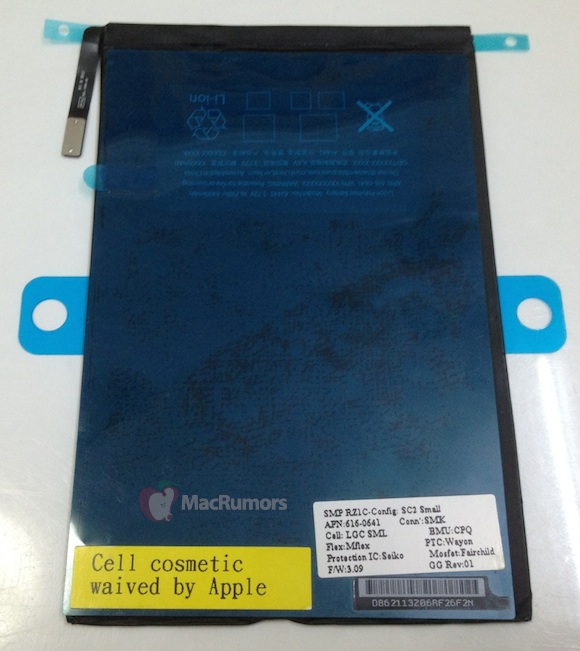
MacRumors has received a pair of photos showing what is claimed to be the battery from Apple's forthcoming "iPad mini". The photos show a battery carrying a model number of A1445 and an Apple part number of 616-0641. The battery runs at 3.72 volts, offering 16.7 Whr of energy on 4490 mAh of charge. 


While we can not confirm the authenticity of the part, the markings are consistent with those seen on batteries from other Apple products. The battery's proportions also seem to fit fairly well with what is expected for the iPad mini, although the exact dimensions of the part are unknown. 


The 16.7 watt-hour capacity for the iPad mini battery unsurprisingly places the device between the iPhone 5 at 5.45 watt-hours and the third-generation full-size iPad at 42.5 watt-hours. Given that the iPad mini has been said to be based more on the iPad 2 and lack a Retina display, the iPad mini's battery may be more appropriately compared to the 25 watt-hour battery of the iPad 2. 

The battery is clearly not yet an official part ready for shipping, as it contains placeholders for several portions of regulatory text and blank rectangular placeholders for a number of regulatory logos. It seems likely, however, that this is the final design simply awaiting final certification. 

Apple is expected to introduce the iPad mini at a media event all but confirmed to bescheduled for October 23.

http://www.macrumors.com/2012/10/14/photos-of-ipad-mini-battery-reveal-16-7-watt-hour-capacity/